
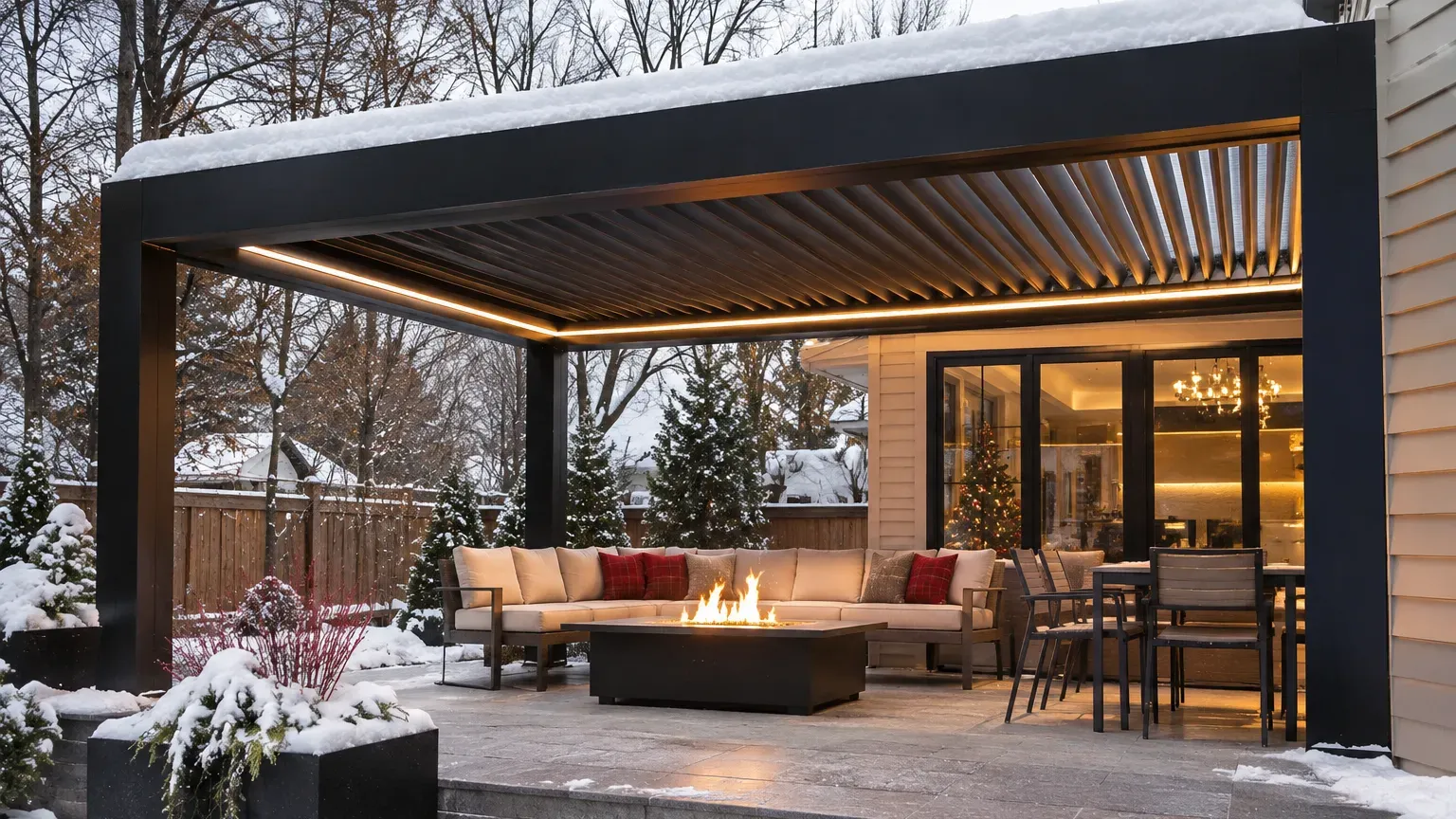
Central Indiana winters test outdoor structures with heavy, wet snow, sudden freezes, and gusty winds, so it’s a fair question: can a motorized pergola actually stand up to a Midwest winter? For homeowners in Carmel, Fishers, Zionsville, Westfield, Noblesville, and Greenwood, the answer depends less on marketing claims and more on how the structure is engineered, built, and installed. The Azenco R-BLADE™ motorized louvered pergola, offered through Homestead Outdoor Living, is engineered with winter conditions in mind, and understanding what actually determines its strength helps homeowners make a confident, informed decision.
What Determines a Pergola's Snow Load Capacity?
Every pergola has a snow load capacity, but that number is never a single, universal figure. It depends on the specific model, the span between supports, the beam size, the connection hardware, and how the whole system is anchored to the ground or an attached structure. Two pergolas that look identical from the street can carry very different loads once engineering details are factored in.
This is why Homestead Outdoor Living treats every project as a site-specific calculation rather than a generic kit. A pergola installed over a wide, unsupported span in an open, wind-exposed yard faces different structural demands than a smaller, wall-mounted unit tucked into a sheltered courtyard. Local snowfall history, roof pitch, and wind exposure all factor into the engineering review before a system is sized and specified for a property.
Homeowners sometimes assume that visible snow depth tells the whole story. It doesn’t. Wet, compacted snow is far heavier than the same depth of light, fresh powder, which is exactly why engineered load calculations, rather than guesswork, are what keep a structure safe through an Indiana winter.
How the Azenco R-BLADE™ Is Built for Midwest Conditions
The Azenco R-BLADE™ is a motorized louvered pergola built from dual-wall aluminum extrusions. The hollow-chamber profile gives each louver meaningful rigidity without adding unnecessary weight, and because aluminum doesn’t absorb moisture or rot, it holds its shape through repeated freeze-thaw cycles that would stress wood or lesser materials over time.
When the louvers are closed, they interlock to form a continuous, sloped surface, and integrated gutters built into the beams channel water away from the structure rather than letting it collect at the edges. That drainage path matters as much in winter as it does during a summer downpour, since melting snow needs somewhere to go besides refreezing against the frame.
Every R-BLADE™ pergola is custom configured. Homeowners can add integrated LED lighting, privacy walls, accessory beams, and weather sensors depending on how they plan to use the space, and the motorized louvers can be adjusted by remote or app for shade, airflow, or a closed, weatherproof position. Exact performance figures, including wind and snow ratings, vary by model, size, and the specific options selected, which is why Homestead Outdoor Living’s design team reviews each property individually rather than quoting a single blanket number.
Why Professional Installation Matters as Much as the Product
A well-engineered pergola can still underperform if it isn’t installed correctly. Anchoring, footing depth, and attachment points all influence how the structure actually behaves under snow and wind load, which is why Homestead Outdoor Living pairs every R-BLADE™ installation with a design consultation, an on-site property evaluation, and custom engineering before a single beam goes into the ground.
During the on-site evaluation, the team looks at exposure, drainage patterns, and the structural connection points that matter most for long-term performance. This step is what turns a general product into a system matched to a specific Indianapolis-area backyard, rooftop, or courtyard.
Previewing Your Pergola Before You Build
Deciding on size, placement, and configuration is easier when a homeowner can actually see the result first. Homestead Outdoor Living’s AI Pergola Visualizer lets homeowners upload a photo of their own patio or backyard and preview how an R-BLADE™ pergola would look in that exact space, with realistic proportion, placement, and finish options shown against the real architecture of the home.
The visualizer is a planning tool, not a final engineering document. It’s a helpful way to compare layouts, finishes, and freestanding versus wall-mounted configurations before a design consultation, so homeowners walk into that conversation with a clearer sense of what they want. Final dimensions, structural specifications, and site requirements are still confirmed by Homestead Outdoor Living’s design team as part of the regular consultation and estimate process.
Frequently Asked Questions
How much snow can a motorized pergola actually hold?
It depends on the specific model, span, and how the structure is installed, not on a single published number. Homestead Outdoor Living calculates load capacity for each property based on the configuration selected and the site’s exposure and snow history.
Does the Azenco R-BLADE™ need special care in winter?
The dual-wall aluminum construction resists moisture absorption and freeze-thaw damage better than wood or vinyl, but routine seasonal attention, such as keeping drainage channels clear, still supports long-term performance.
Should the louvers be open or closed during a snowstorm?
Homeowners should follow the guidance provided by Homestead Outdoor Living for their specific installation. In general, a closed, sloped louver surface sheds precipitation more effectively than an open one, which is why closed positioning is the standard recommendation before a storm.
Can I see how a pergola would look on my own property before committing?
Yes. The AI Pergola Visualizer lets homeowners preview an R-BLADE™ pergola on an actual photo of their patio or yard, which makes it easier to evaluate size, placement, and finish before moving into a design consultation.
Does a motorized pergola need a permit in Central Indiana?
Permit requirements vary by municipality. Homestead Outdoor Living recommends confirming local requirements with the relevant building department as part of the design and installation process.
Schedule Your Free Design Consultation
A motorized pergola built for a Midwest winter starts with an honest look at the property it will stand on. Homestead Outdoor Living’s design consultation reviews span, anchoring, drainage, and site exposure so the final configuration is engineered for the realities of a Central Indiana winter rather than a generic average. Schedule your free design consultation.